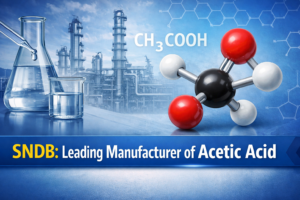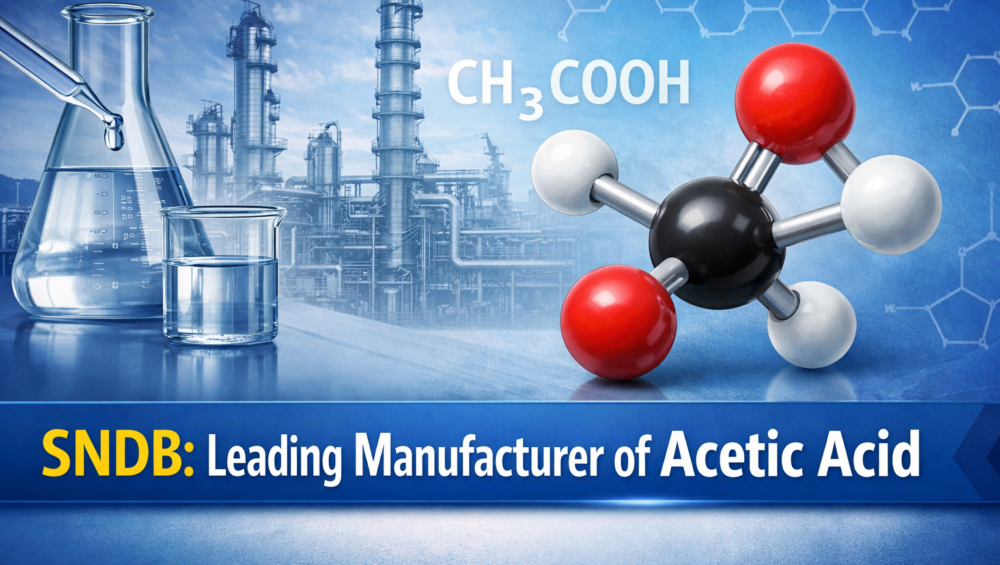
One of the most significant carboxylic acids in organic chemistry and industry is acetic acid (CH3COOH), sometimes referred to as ethanoic acid. It is commonly known as the primary ingredient in vinegar and is an essential raw material for the production of chemicals, medicines, food, textiles, and polymers. SNDB best Manufacturer of Acetic Acid Based in India, SNDB is a reputable producer, distributor, and exporter of high-grade acetic acid (CH3COOH). Through decades of operations, a commitment to quality, and the ability to supply globally, the company has established a solid name in the chemical sector.
These companies use advanced processes such as methanol carbonylation to produce high-purity acetic acid for industrial applications.
Physicochemical Properties of Acetic Acid
1. Physical Properties
- Molecular Formula: CH₃COOH
- Molar Mass: 60.05 g/mol
- Appearance: Colorless liquid
- Odor: Strong, pungent smell
- Boiling Point: 118.1°C
- Melting Point: 16.6°C (called glacial acetic acid when pure and solidified)
- Density: 1.049 g/cm³
- Solubility: Completely miscible with water
Acetic acid forms hydrogen bonds, which contribute to its relatively high boiling point compared to other organic compounds of similar molecular weight.
2. Chemical Properties
- Weak organic acid (pKa ≈ 4.76)
- Ionizes in water to form acetate ions (CH₃COO⁻)
- Corrosive in concentrated form
- Acts as both a solvent and a reagent
Reactivity of Acetic Acid
Acetic acid participates in several important chemical reactions:
1. Acid-Base Reactions
It reacts with bases to form acetate salts and water.
Example:
CH₃COOH + NaOH → CH₃COONa + H₂O
2. Esterification
Reacts with alcohols in the presence of an acid catalyst to form esters.
Example:
CH₃COOH + C₂H₅OH → CH₃COOC₂H₅ + H₂O
3. Formation of Acid Chlorides
Reacts with thionyl chloride (SOCl₂) to produce acetyl chloride.
4. Decarboxylation
Under specific conditions, it can lose carbon dioxide to form methane derivatives.
5. Oxidation and Reduction
Although relatively stable, it can undergo reduction to ethanol or oxidation under strong conditions.
Industrial Importance
Acetic acid is primarily used in the production of:
- Vinyl acetate monomer (VAM)
- Acetic anhydride
- Ester solvents
- Purified terephthalic acid (PTA)
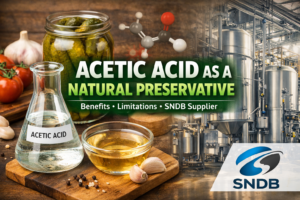
- Food preservatives
Its versatility makes it one of the most demanded organic acids worldwide.
Safety Considerations
- Concentrated acetic acid can cause skin burns.
- Vapors may irritate respiratory passages.
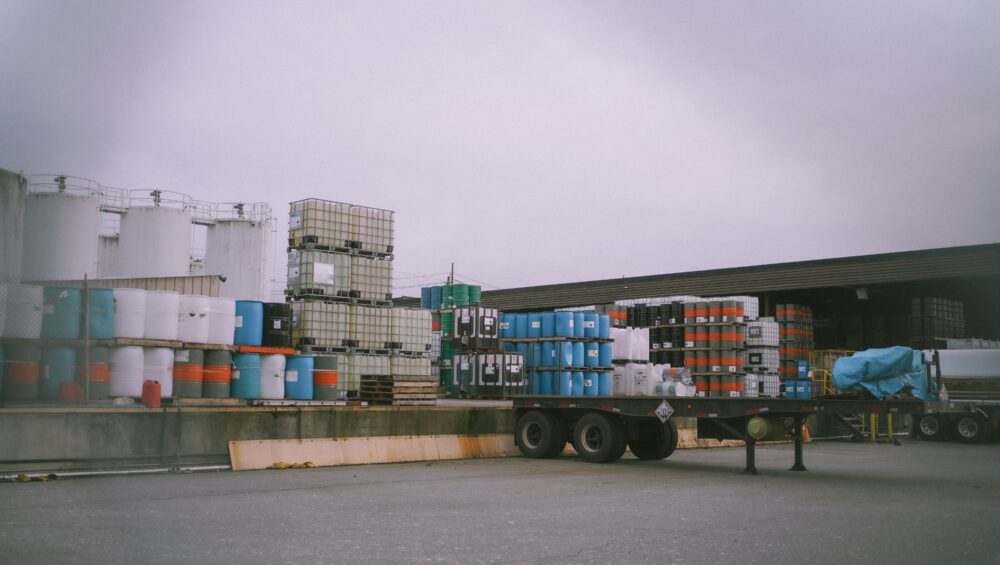
- Proper storage in corrosion-resistant containers is required.
Frequently Asked Questions (FAQs)
1. What is glacial acetic acid?
Glacial acetic acid is pure (99–100%) acetic acid that solidifies below 16.6°C, forming ice-like crystals.
2. Why is acetic acid considered a weak acid?
It partially ionizes in water, meaning it does not completely dissociate like strong acids such as hydrochloric acid.
3. How is acetic acid produced industrially?
It is mostly made by methanol carbonylation, which is a catalytic reaction between methanol and carbon monoxide.
4. What are the main uses of acetic acid?
It is used in producing polymers, textiles, adhesives, solvents, and food preservatives.
5. Is acetic acid dangerous?
In diluted form (like vinegar), it is safe. In concentrated form, it is corrosive and must be handled with protective equipment.