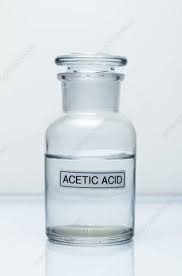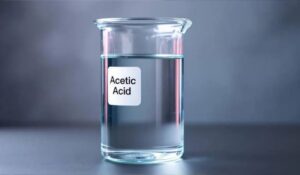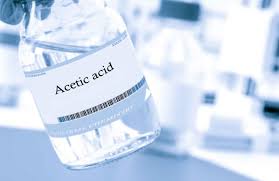
Acetic acid, with the chemical formula CH₃COOH, is a weak organic acid best known as the main active component of vinegar. It is responsible for vinegar’s characteristic sour taste and pungent smell. Beyond food, acetic acid plays an important role in chemistry, industry, and everyday life.
What is Acetic Acid?
Acetic acid is a carboxylic acid, meaning it contains the functional group –COOH (carboxyl group). Its structure consists of a methyl group (CH₃–) attached to a carboxyl group (–COOH).
Basic properties:
- Chemical formula: CH₃COOH
- Molar mass: 60.05 g/mol
- Appearance: Colorless liquid
- Odor: Strong vinegar-like smell
- Nature: Weak acid
When dissolved in water, acetic acid partially ionizes, releasing hydrogen ions (H⁺), which gives it acidic properties.
Acetic Acid in Vinegar
Vinegar is essentially a dilute solution of acetic acid in water, typically containing about 4–8% acetic acid.
How it is formed:
Vinegar is produced through a two-step fermentation process:
- Alcoholic fermentation:
Sugars → Ethanol (C₂H₅OH) - Acetic acid fermentation:
Ethanol + Oxygen → Acetic acid + Water
(done by Acetobacter bacteria)
This biological process converts alcoholic liquids (like wine or cider) into vinegar.
Chemical Behavior of Acetic Acid
Although acetic acid is classified as a weak acid, it still shows typical acid reactions:
1. Dissociation in water:
CH₃COOH ⇌ CH₃COO⁻ + H⁺
2. Reaction with bases (neutralization):
CH₃COOH + NaOH → CH₃COONa + H₂O
(sodium acetate + water)
3. Reaction with metals:
It reacts slowly with metals like zinc, producing hydrogen gas.
Uses of Acetic Acid
Acetic acid is not only found in vinegar but is widely used in different industries:
Food industry:
- Preservative in pickles and sauces
- Flavoring agent
Chemical industry:
- Production of acetate salts
- Manufacture of plastics like polyvinyl acetate (PVA)
- Used in solvents and dyes
Laboratory use:
- Acid-base titrations
- Preparation of buffer solutions
Household use:
- Cleaning agent
- Deodorizing and disinfecting surfaces
Physical and Chemical Importance
Acetic acid is important in chemistry because it helps demonstrate:
- Weak acid behavior
- Equilibrium concepts
- Buffer systems (acetic acid + sodium acetate)
- Organic reaction mechanisms
Safety and Handling
Concentrated acetic acid (glacial acetic acid) is corrosive and should be handled carefully:
- Can cause skin burns
- Irritates eyes and respiratory system
- Should be used with protective equipment in labs
Acetic acid is a simple yet highly important compound in both nature and industry. As the main component of vinegar, it connects everyday life with fundamental chemical principles. From food preservation to industrial manufacturing, CH₃COOH plays a vital role in chemistry and human life.
SNDB is a trusted manufacturer, supplier, and exporter known for delivering high-quality acetic acid used across industries such as food processing, chemicals, pharmaceuticals, and textiles. The company focuses on maintaining strict quality standards, ensuring purity, and providing reliable supply chains to meet both domestic and international demand. With strong production capabilities and efficient logistics, SNDB has built a reputation for consistent performance, timely delivery, and customer satisfaction, making it a preferred partner in the global chemical market.