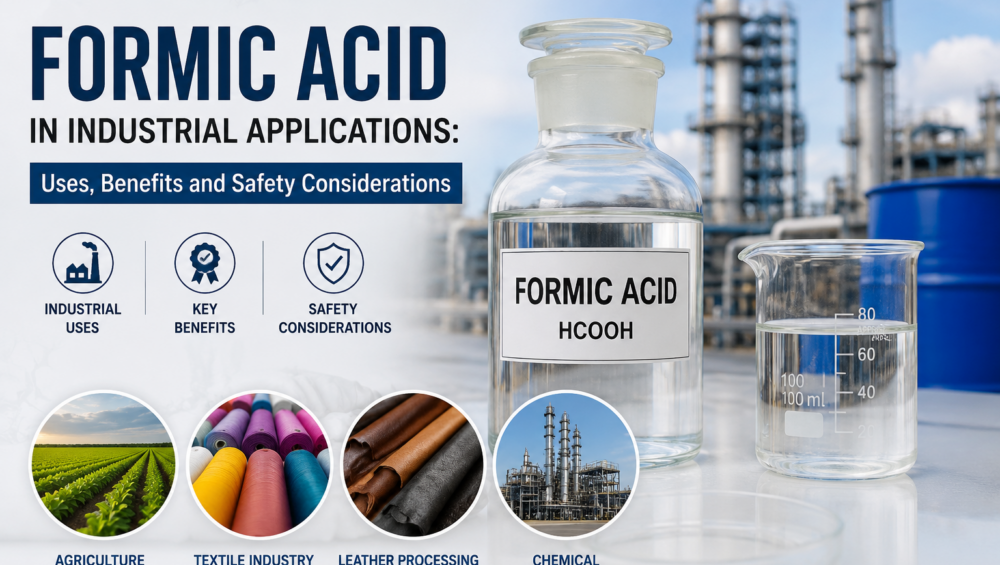
Formic acid is a versatile organic acid widely used across agriculture, textiles, leather processing, chemical manufacturing, and several other industrial sectors. Known for its strong acidic properties and relatively simple chemical structure, formic acid plays an important role in processes that require an effective acidifying, reducing, or preservative agent.
SNDB provides industrial chemical solutions for businesses that require quality and reliable raw materials for different manufacturing applications.
What Is Formic Acid?
Formic acid is the simplest carboxylic acid, with the chemical formula HCOOH. It is also known as methanoic acid. In its pure form, it is a colorless liquid with a sharp, pungent odor.
Formic acid is valued in industrial applications because of its acidity, solubility, and ability to participate in various chemical reactions. Depending on the required application, it can be supplied in different concentrations and grades.
Key Properties of Formic Acid
Some important characteristics of formic acid include:
- Chemical formula: HCOOH
- IUPAC name: Methanoic acid
- Appearance: Colorless liquid
- Molecular weight: Approximately 46.03 g/mol
- Nature: Organic carboxylic acid
- Odor: Strong and pungent
- Solubility: Highly soluble in water
- Acidity: Stronger than many common organic acids
These properties make formic acid suitable for applications where controlled acidity and chemical reactivity are required.
Major Industrial Applications of Formic Acid
1. Agriculture and Animal Feed
One of the important applications of formic acid is in the agricultural and animal-feed industries. It can be used as an acidifying and preservative agent in certain feed applications.
Formic acid helps create an acidic environment that can support feed preservation and reduce the growth of certain undesirable microorganisms. It is also used in silage treatment to support proper fermentation and preservation.
2. Textile Industry
Formic acid is used in several textile processing operations. Its acidic nature makes it useful for controlling pH during dyeing and finishing processes.
Maintaining the appropriate pH is important for achieving consistent results in textile production. Formic acid can therefore support controlled processing and improve process efficiency when used according to specific manufacturing requirements.
3. Leather Processing
The leather industry uses formic acid during different stages of leather processing, including pickling and pH adjustment.
Its ability to provide controlled acidity makes it useful for preparing hides and skins for subsequent processing steps. Proper use can contribute to consistent processing conditions and product quality.
4. Chemical Manufacturing
Formic acid is an important raw material and processing chemical in the chemical industry. It can participate in various chemical reactions and is used in the production of different chemical compounds.
Its reducing and acidic properties make it useful in specialized chemical manufacturing processes.
5. Rubber and Latex Processing
Formic acid can be used as a coagulant in natural rubber and latex processing. Controlled coagulation is essential for separating rubber from latex during manufacturing.
The concentration and processing conditions need to be carefully controlled to achieve the desired results.
6. Pharmaceuticals and Specialty Chemicals
Formic acid may be used as a processing agent or chemical intermediate in certain pharmaceutical and specialty-chemical manufacturing processes.
Because pharmaceutical and specialty chemical production requires strict quality control, the appropriate grade, concentration, purity, and handling procedures should always be followed.
7. Cleaning and Descaling Applications
Because of its acidic properties, formic acid can be used in selected industrial cleaning and descaling applications. It can help remove certain mineral deposits and residues from equipment and surfaces.
Its suitability depends on the material being cleaned and the specific formulation. Compatibility testing is recommended before large-scale use.
Benefits of Formic Acid in Industrial Processes
Formic acid offers several advantages for industrial users:
Effective Acidifying Agent
Its strong acidic nature allows formic acid to provide controlled pH adjustment in various industrial processes.
Versatile Applications
From agriculture and leather processing to textiles and chemical manufacturing, formic acid can serve multiple industrial purposes.
Good Water Solubility
Formic acid mixes readily with water, making it convenient for many aqueous industrial formulations and processes.
Useful Chemical Reactivity
Its chemical properties allow it to function as a reactant, processing aid, acidifying agent, or reducing agent depending on the application.
Supports Process Control
When used at appropriate concentrations, formic acid can help manufacturers maintain desired processing conditions and improve consistency.
Safety Considerations When Handling Formic Acid
Formic acid is a corrosive chemical and must be handled carefully. Direct exposure can cause irritation or burns to the skin and eyes, while inhalation of concentrated vapors can irritate the respiratory system.
Industrial users should follow the applicable Safety Data Sheet (SDS) and workplace chemical-safety procedures.
Important precautions include:
- Use suitable chemical-resistant gloves and protective clothing.
- Wear appropriate eye and face protection.
- Ensure adequate ventilation during handling.
- Avoid direct contact with skin and eyes.
- Use appropriate containers and compatible equipment.
- Store the chemical according to the supplier’s recommendations.
- Keep emergency washing facilities accessible.
- Train employees in proper chemical handling procedures.
- Follow local regulations for storage, transportation, and disposal.
The exact safety requirements depend on the concentration, grade, quantity, and application.
Storage and Handling
Proper storage is essential for maintaining product quality and workplace safety. Formic acid should be stored in suitable, compatible containers in a well-ventilated area.
Containers should remain properly closed when not in use. Storage areas should be designed to minimize the risk of accidental exposure and should follow applicable chemical-storage regulations.
Before using formic acid in an industrial process, manufacturers should review the supplier’s technical documentation and SDS for specific handling and storage requirements.
Why Choose a Reliable Formic Acid Supplier?
Industrial production requires consistent chemical quality and dependable supply. Choosing a reliable supplier can help manufacturers maintain consistent production standards and reduce interruptions.
When selecting formic acid for industrial use, businesses should consider:
- Product purity and grade
- Required concentration
- Quality specifications
- Packaging options
- Technical documentation
- Safety Data Sheet availability
- Supply consistency
- Application requirements
A dependable supplier can help businesses select the appropriate product specification for their particular industrial process.
Formic acid is a versatile industrial chemical with applications across agriculture, animal feed, textiles, leather, rubber and latex, chemical manufacturing, pharmaceuticals, and industrial cleaning. Its strong acidity, water solubility, and chemical reactivity make it valuable for processes requiring controlled acidity or specific chemical reactions.
However, formic acid must be handled responsibly because concentrated material can be corrosive. Proper PPE, ventilation, storage, training, and adherence to the relevant SDS are essential for safe industrial use.
SNDB focuses on providing chemical products and solutions for industrial requirements, helping businesses source materials according to their application and quality specifications.