Understanding Acetic Acid (CH₃COOH): The Chemistry of VinegarCategoriesUncategorized

Understanding Acetic Acid (CH₃COOH): The Chemistry of Vinegar

Acetic acid, with the chemical formula CH₃COOH, is a weak organic acid best known as the main active component of vinegar. It is responsible for vinegar’s characteristic sour taste and pungent smell. Beyond food, acetic acid plays an important role in chemistry, industry, and everyday life.

What is Acetic Acid?

Acetic acid is a carboxylic acid, meaning it contains the functional group –COOH (carboxyl group). Its structure consists of a methyl group (CH₃–) attached to a carboxyl group (–COOH).

Basic properties:

  • Chemical formula: CH₃COOH
  • Molar mass: 60.05 g/mol
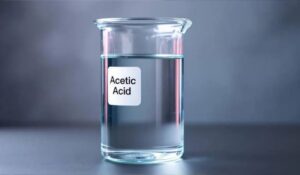
  • Appearance: Colorless liquid
  • Odor: Strong vinegar-like smell
  • Nature: Weak acid

When dissolved in water, acetic acid partially ionizes, releasing hydrogen ions (H⁺), which gives it acidic properties.

Acetic Acid in Vinegar

Vinegar is essentially a dilute solution of acetic acid in water, typically containing about 4–8% acetic acid.

How it is formed:

Vinegar is produced through a two-step fermentation process:

  1. Alcoholic fermentation:
    Sugars → Ethanol (C₂H₅OH)
  2. Acetic acid fermentation:
    Ethanol + Oxygen → Acetic acid + Water
    (done by Acetobacter bacteria)

This biological process converts alcoholic liquids (like wine or cider) into vinegar.

Chemical Behavior of Acetic Acid

Although acetic acid is classified as a weak acid, it still shows typical acid reactions:

1. Dissociation in water:

CH₃COOH ⇌ CH₃COO⁻ + H⁺

2. Reaction with bases (neutralization):

CH₃COOH + NaOH → CH₃COONa + H₂O
(sodium acetate + water)

3. Reaction with metals:

It reacts slowly with metals like zinc, producing hydrogen gas.

Uses of Acetic Acid

Acetic acid is not only found in vinegar but is widely used in different industries:

Food industry:

  • Preservative in pickles and sauces
  • Flavoring agent

Chemical industry:

  • Production of acetate salts
  • Manufacture of plastics like polyvinyl acetate (PVA)
  • Used in solvents and dyes

Laboratory use:

  • Acid-base titrations
  • Preparation of buffer solutions

Household use:

  • Cleaning agent
  • Deodorizing and disinfecting surfaces

Physical and Chemical Importance

Acetic acid is important in chemistry because it helps demonstrate:

  • Weak acid behavior
  • Equilibrium concepts
  • Buffer systems (acetic acid + sodium acetate)
  • Organic reaction mechanisms

Safety and Handling

Concentrated acetic acid (glacial acetic acid) is corrosive and should be handled carefully:

  • Can cause skin burns
  • Irritates eyes and respiratory system
  • Should be used with protective equipment in labs

Acetic acid is a simple yet highly important compound in both nature and industry. As the main component of vinegar, it connects everyday life with fundamental chemical principles. From food preservation to industrial manufacturing, CH₃COOH plays a vital role in chemistry and human life.

SNDB is a trusted manufacturer, supplier, and exporter known for delivering high-quality acetic acid used across industries such as food processing, chemicals, pharmaceuticals, and textiles. The company focuses on maintaining strict quality standards, ensuring purity, and providing reliable supply chains to meet both domestic and international demand. With strong production capabilities and efficient logistics, SNDB has built a reputation for consistent performance, timely delivery, and customer satisfaction, making it a preferred partner in the global chemical market.
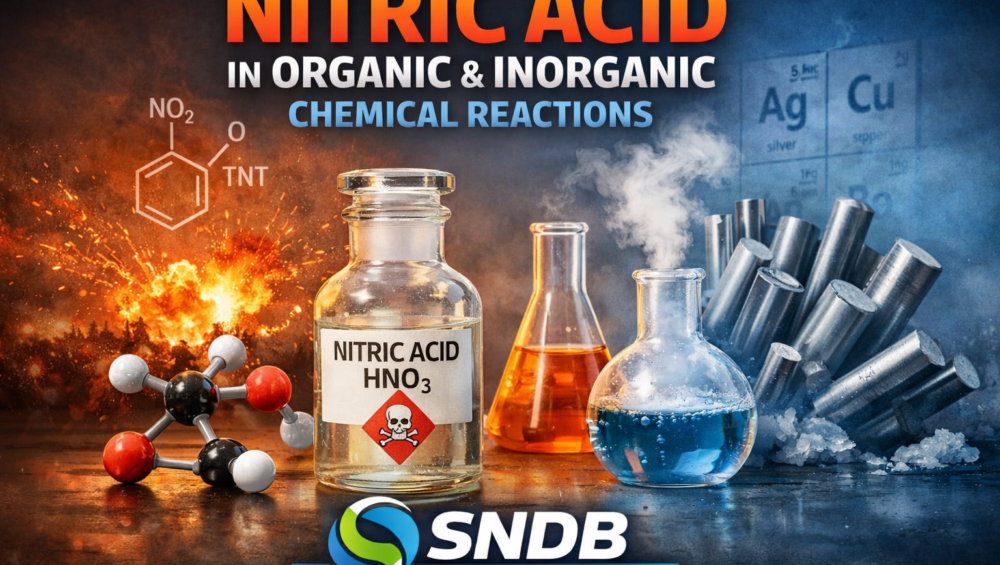
Nitric Acid in Organic and Inorganic Chemical Reactions | SNDB – Best ManufacturerCategoriesNitric Acid

Nitric Acid in Organic and Inorganic Chemical Reactions | SNDB – Best Manufacturer

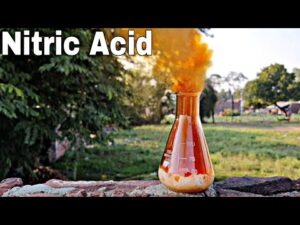
Nitric acid (HNO₃) is one of the most important mineral acids used in modern chemistry and industry. Known for its strong oxidizing properties and high reactivity, nitric acid plays a crucial role in both organic and inorganic chemical reactions. It is widely used in the production of fertilizers, explosives, dyes, pharmaceuticals, and various industrial chemicals.

As a leading manufacturer, SNDB is recognized for producing high-quality nitric acid that meets the needs of laboratories, research institutions, and industrial applications.

What is Nitric Acid?

Nitric acid is a colorless to slightly yellow liquid with a sharp, pungent odor. It is highly corrosive and a powerful oxidizing agent. Due to these properties, nitric acid is extensively used in chemical synthesis and manufacturing processes.

Chemically, nitric acid is represented by the formula HNO₃ and is formed from nitrogen, oxygen, and hydrogen. In industry, it is typically produced using the Ostwald process, which converts ammonia into nitric acid through catalytic oxidation.

Nitric Acid in Organic Chemical Reactions

In organic chemistry, nitric acid is mainly used as a nitrating and oxidizing agent. It plays a key role in introducing nitro groups (–NO₂) into organic molecules.

1. Nitration Reactions

One of the most common uses of nitric acid is nitration, where a nitro group is added to an organic compound. This reaction is essential in the production of:

  • Nitrobenzene
  • Trinitrotoluene (TNT)
  • Nitrocellulose
  • Various dyes and pharmaceuticals

Nitration reactions are typically carried out using a mixture of nitric acid and sulfuric acid, which increases the efficiency of the reaction.

2. Oxidation Reactions

Nitric acid is also used to oxidize organic compounds, converting alcohols, aldehydes, and other molecules into more oxidized products such as acids. These reactions are important in the synthesis of many industrial chemicals.

3. Production of Explosives and Energetic Materials

Nitric acid is a critical component in manufacturing explosives and propellants. Through nitration reactions, it helps produce materials such as nitroglycerin and other high-energy compounds used in mining, construction, and defense industries.

Nitric Acid in Inorganic Chemical Reactions

Nitric acid is equally important in inorganic chemistry due to its ability to react with metals, oxides, and salts.

1. Reaction with Metals

Nitric acid reacts with many metals to produce metal nitrates, nitrogen oxides, and water. Unlike many other acids, nitric acid often acts as a strong oxidizing agent during these reactions.

2. Formation of Metal Nitrates

Metal nitrates produced from nitric acid are widely used in:

  • Fertilizer manufacturing
  • Chemical synthesis
  • Metal processing industries

These compounds are essential for agricultural and industrial applications.

3. Laboratory Applications

In laboratories, nitric acid is commonly used for:

  • Preparing chemical reagents
  • Cleaning laboratory equipment
  • Metal dissolution and analysis

Its strong oxidizing nature makes it particularly useful in analytical chemistry.

Industrial Importance of Nitric Acid

Nitric acid plays a significant role in global industrial production. Major applications include:

  • Fertilizer manufacturing (ammonium nitrate production)
  • Explosives production
  • Metal processing and refining
  • Chemical synthesis and pharmaceuticals
  • Dye and pigment production

Because of its versatility, nitric acid remains a fundamental chemical in many sectors.

SNDB – A Trusted Nitric Acid Manufacturer

When it comes to reliable supply and consistent quality, SNDB stands out as a trusted nitric acid manufacturer. The company focuses on:

  • High-purity nitric acid production
  • Advanced manufacturing technology
  • Strict quality control standards
  • Reliable supply for industrial and research applications

By maintaining high production standards, SNDB ensures that customers receive nitric acid suitable for both organic and inorganic chemical processes.

Nitric acid is a vital chemical reagent used in numerous organic and inorganic reactions. From nitration in organic synthesis to the production of metal nitrates in inorganic chemistry, its applications are extensive and essential to modern industry.

With growing demand across fertilizers, pharmaceuticals, and chemical manufacturing, trusted producers like SNDB continue to play an important role in supplying high-quality nitric acid to global markets.

SNDB as a Reliable Exporter of Acetic Acid to Global MarketsCategoriesUncategorized

SNDB – Best Manufacturer and Exporter | Role of Acetic Acid in Organic and Biochemical Processes

One of the most significant organic acids utilized in the food, chemical, pharmaceutical, and biochemical sectors is acetic acid. This substance, which is well-known for being straightforward and adaptable, is essential to biological systems and organic synthesis. SNDB is a reputable producer and exporter of premium acetic acid, providing industries all over the world with dependable and consistent products as demand for the product rises.

Understanding Acetic Acid

The white liquid known as acetic acid (CH3COOH) has a strong smell. It is an essential building block in organic chemistry and the primary ingredient in vinegar. Acetic acid is involved in a variety of chemical and biological reactions because of its acidic nature and reactive carboxyl group.

Role of Acetic Acid in Organic Processes

  1. Key Reagent in Organic Synthesis
    Acetic acid is widely used as a solvent and reagent in organic chemistry. It participates in esterification reactions to produce acetate esters, which are essential in coatings, adhesives, inks, and solvents.
  2. Intermediate for Industrial Chemicals
    In large-scale chemical manufacturing, acetic acid is a precursor for products such as:
  • Acetic anhydride
  • Vinyl acetate monomer (VAM)
  • Acetate salts and esters

These derivatives are further used in plastics, textiles, pharmaceuticals, and synthetic fibers.

  1. Catalyst and pH Regulator
    Acetic acid is frequently used to regulate reaction acidity, increasing yield and reaction efficiency. It is perfect for controlled industrial processes because of its predictable nature.

Role of Acetic Acid in Biochemical Processes

  1. Metabolic Importance
    Acetic acid and metabolism are intimately related in biological systems. It is present as acetyl-CoA, a key component in the synthesis of fatty acids, amino acids, and carbohydrates as well as energy production.
  2. Microbial Fermentation
    In microbial fermentation, acetic acid is both a byproduct and a regulator. It is made by acetic acid bacteria and is used in biotechnology, food processing, and the synthesis of enzymes.
  3. Preservation and Antimicrobial Action
    Thanks to its ability to inhibit microbial growth, acetic acid is used in biochemical and food applications as a preservative and antimicrobial agent.

Applications Across Industries

  • Pharmaceuticals: Used in drug synthesis and formulation
  • Food Industry: Acidity regulator and preservative
  • Textiles: Dyeing and finishing processes
  • Agriculture: Herbicides and silage preservation
  • Biotechnology: Fermentation and biochemical research

Why Choose SNDB as Your Acetic Acid Manufacturer and Exporter

SNDB is recognized as a reliable manufacturer and exporter of acetic acid, delivering products that meet international quality standards. With advanced manufacturing facilities and strict quality control systems, SNDB ensures:

  • High purity and consistent quality
  • Compliance with global safety and regulatory norms
  • Secure packaging for domestic and international transport
  • Timely delivery and dependable supply chain support

SNDB serves a diverse global client base across chemical, pharmaceutical, food, and industrial sectors, making it a preferred partner for bulk and customized acetic acid requirements.

The role of acetic acid in organic and biochemical processes is fundamental and far-reaching. This adaptable substance has a wide range of uses, from biological metabolism to industrial production. SNDB continues to solidify its position as a top producer and exporter of acetic acid, helping sectors that depend on accuracy and efficiency, thanks to its dedication to quality, dependability, and global reach.