How Nitric Acid is Produced: A Complete Guide to the Ostwald ProcessCategoriesNitric Acid

How Nitric Acid is Produced: A Complete Guide to the Ostwald Process

Nitric acid (HNO₃) is one of the most important industrial chemicals used worldwide. It plays a vital role in the production of fertilizers, explosives, dyes, pharmaceuticals, and numerous chemical compounds. The majority of commercial nitric acid is produced through the Ostwald Process, a highly efficient and widely adopted industrial method.

As a leading manufacturer, supplier, and exporter of industrial chemicals, SNDB is committed to delivering high-quality nitric acid products that meet international standards and diverse industrial requirements.

What is Nitric Acid?

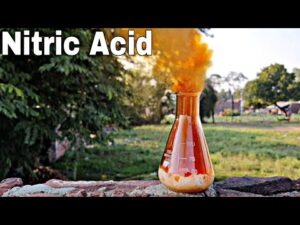
Nitric acid is a strong mineral acid known for its highly corrosive and oxidizing properties. It is a colorless liquid that may develop a yellow tint due to the decomposition into nitrogen oxides over time. Industries rely heavily on nitric acid for manufacturing fertilizers, metal processing, and chemical synthesis.

Understanding the Ostwald Process

The Ostwald Process, developed by German chemist Wilhelm Ostwald in the early 20th century, is the primary industrial method used for producing nitric acid from ammonia.

The process consists of three major stages:

Step 1: Catalytic Oxidation of Ammonia

The process begins with the oxidation of ammonia (NH₃) using atmospheric oxygen in the presence of a platinum-rhodium catalyst at temperatures ranging from 800°C to 900°C.

Chemical Reaction:

4NH₃ + 5O₂ → 4NO + 6H₂O

This reaction produces nitric oxide (NO) and water vapor.

Step 2: Oxidation of Nitric Oxide

The nitric oxide formed in the first stage is further oxidized by atmospheric oxygen to produce nitrogen dioxide (NO₂).

Chemical Reaction:

2NO + O₂ → 2NO₂

Nitrogen dioxide is a reddish-brown gas and serves as an intermediate compound in nitric acid production.

Step 3: Absorption in Water

The nitrogen dioxide gas is then absorbed in water inside absorption towers, producing nitric acid.

Chemical Reaction:

3NO₂ + H₂O → 2HNO₃ + NO

The nitric oxide generated during this stage is recycled back into the process, making the Ostwald Process highly efficient and environmentally sustainable.

Advantages of the Ostwald Process

The Ostwald Process offers several advantages, including:

  • High production efficiency.
  • Large-scale commercial applicability.
  • Continuous operation capability.
  • Lower production costs.
  • Recycling of intermediate gases.
  • Consistent production of high-purity nitric acid.

These benefits make it the preferred industrial method for nitric acid manufacturing across the globe.

Industrial Applications of Nitric Acid

Nitric acid produced through the Ostwald Process is extensively used in various industries, including:

Fertilizer Manufacturing

Nitric acid is a key ingredient in producing ammonium nitrate fertilizers, which significantly improve agricultural productivity.

Explosives Industry

It is widely used in the manufacture of explosives for mining, construction, and defense applications.

Metal Processing

Industries use nitric acid for metal pickling, cleaning, etching, and refining processes.

Chemical Manufacturing

Nitric acid serves as a crucial raw material in producing dyes, pharmaceuticals, plastics, and specialty chemicals.

Safety Considerations in Nitric Acid Production

Since nitric acid is highly corrosive, strict safety measures are essential during manufacturing, storage, and transportation.

Important safety practices include:

  • Using corrosion-resistant equipment.
  • Wearing appropriate personal protective equipment (PPE).
  • Ensuring adequate ventilation.
  • Implementing proper storage protocols.
  • Following environmental and industrial safety regulations.

Why Choose SNDB for Nitric Acid?

SNDB has established itself as a trusted name in the chemical industry by delivering superior-quality nitric acid to customers worldwide. As a leading manufacturer, supplier, and exporter, SNDB focuses on quality, consistency, and customer satisfaction.

Why Industries Prefer SNDB:

  • Premium quality nitric acid products.
  • Advanced manufacturing facilities.
  • Strict quality control procedures.
  • Timely delivery across domestic and international markets.
  • Competitive pricing.
  • Customized packaging solutions.
  • Dedicated customer support.

With years of industry expertise and a commitment to excellence, SNDB continues to serve industries with reliable and high-performance chemical solutions.

The Ostwald Process remains the backbone of modern nitric acid production due to its efficiency, scalability, and sustainability. As demand for nitric acid continues to grow across industries, partnering with a reliable supplier becomes increasingly important.

SNDB stands as a trusted manufacturer, supplier, and exporter of high-quality nitric acid, offering dependable products that meet the evolving needs of industries worldwide.
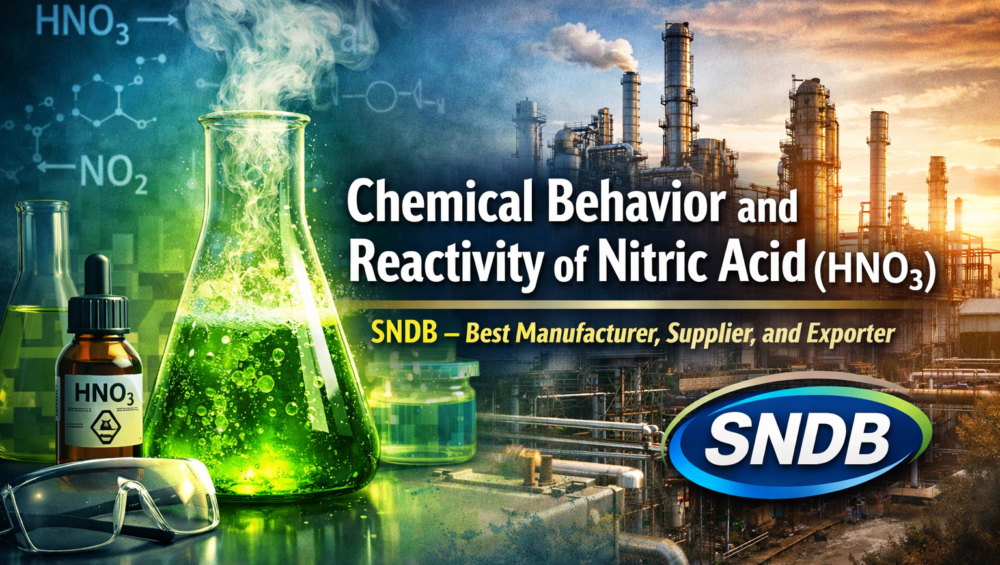
Chemical Behavior and Reactivity of Nitric Acid (HNO₃) SNDB – Best Manufacturer, Supplier, and ExporterCategoriesNitric Acid

Chemical Behavior and Reactivity of Nitric Acid (HNO₃)| SNDB Best Manufacturer and supplier

One of the most significant mineral acids utilized in contemporary chemical industries is nitric acid (HNO₃). Nitric acid, which is well-known for its potent oxidizing and strong acidic qualities, is essential to the synthesis of fertilizer, explosives, metals, medicines, dyes, and laboratory research. Being a top producer, supplier, and exporter, SNDB provides premium nitric acid that satisfies exacting industrial and global requirements.

Chemical Properties of Nitric Acid

Nitric acid is a colorless to light yellow liquid with a strong, unpleasant smell. It dissolves easily in water and has the chemical formula HNO₃. Compared to concentrated nitric acid, which typically contains about 68% HNO₃ by weight, fuming nitric acid has a higher HNO₃ level.

1. Strong Acidic Nature

Nitric acid is a strong monoprotic acid, meaning it completely dissociates in water:

HNO₃ → H⁺ + NO₃⁻

Because of complete ionization, it has a very low pH and reacts readily with bases to form nitrates and water in neutralization reactions.

Example:
HNO₃ + NaOH → NaNO₃ + H₂O

Oxidizing Behavior

Nitric acid’s potent oxidizing power is one of its most crucial properties. When nitric acid reacts with metals, it usually does not release hydrogen gas, in contrast to many other acids. Rather, it reduces to nitrogen oxides like NO₂ or NO by oxidizing metals.

Reaction with Metals

With copper:
Cu + 4HNO₃ (conc.) → Cu(NO₃)₂ + 2NO₂ + 2H₂O

With dilute acid, nitric oxide (NO) is formed instead of nitrogen dioxide (NO₂).

This powerful oxidizing property makes nitric acid highly useful in metal refining, etching, and cleaning processes.

Reaction with Non-Metals

Nitric acid also reacts with non-metals such as carbon and sulfur due to its oxidizing nature.

Example:
C + 4HNO₃ → CO₂ + 4NO₂ + 2H₂O

These reactions demonstrate its ability to oxidize non-metallic substances effectively.

Nitration Reactions

In nitration processes, which add a nitro group (-NO₂) into organic molecules, nitric acid is essential. Pharmaceuticals, dyes, and explosives are all produced using this method.

For example, in the presence of sulfuric acid, nitric acid generates the nitronium ion (NO₂⁺), a powerful electrophile used in aromatic substitution reactions.

Applications include:

  • Production of nitrobenzene
  • Manufacture of trinitrotoluene (TNT)
  • Synthesis of nitroglycerin

Thermal Decomposition

When exposed to heat or light, concentrated nitric acid decomposes:

4HNO₃ → 4NO₂ + 2H₂O + O₂

The brown fumes observed are nitrogen dioxide (NO₂). This decomposition explains why nitric acid is stored in dark containers to prevent breakdown.

Industrial Production

Nitric acid is industrially produced through the Ostwald process, which involves the catalytic oxidation of ammonia to nitric oxide, followed by further oxidation and absorption in water.

This process ensures large-scale, efficient production for global industrial demand.

Safety and Handling

Due to its corrosive and oxidizing nature, nitric acid must be handled with strict safety measures:

  • Use corrosion-resistant storage tanks
  • Ensure proper ventilation
  • Wear protective gloves, goggles, and chemical-resistant clothing
  • Store away from organic materials and reducing agents

Proper storage and transportation are essential for maintaining quality and safety.

Why Choose SNDB as Your Nitric Acid Partner?

As a trusted manufacturer, supplier, and exporter, SNDB provides:

  • High-purity nitric acid in various concentrations
  • Compliance with international quality standards
  • Secure packaging and global export capability
  • Timely delivery and competitive pricing
  • Dedicated customer support

With advanced production facilities and quality control systems, SNDB ensures consistent product performance for industrial and laboratory applications worldwide.

Strong and extremely reactive, nitric acid (HNO₃) has potent oxidizing qualities that make it essential in many different sectors. Its chemical behavior determines its adaptability in a variety of processes, including organic synthesis, fertilizer production, and metal processing. Every shipment is guaranteed to be efficient, safe, and of high quality when working with a reputable supplier like SNDB.

For bulk inquiries, customized packaging, or export orders, SNDB stands ready as your best manufacturer, supplier, and exporter of premium nitric acid.

Nitric Acid: The Backbone of Fertilizer Industry| sndbCategoriesNitric Acid

Nitric Acid: The Backbone of Fertilizer Industry

Nitric Acid (HNO₃) is one of the most important industrial chemicals and plays a vital role in the fertilizer industry. It is a strong acid and powerful oxidizing agent used in the production of nitrogen-based fertilizers, which are essential for modern agriculture and global food production. Around 75–80% of nitric acid produced worldwide is used in fertilizers, which is why nitric acid is called the backbone of the fertilizer industry.

What is Nitric Acid?

Nitric acid is a colorless to yellowish, highly corrosive mineral acid with the chemical formula HNO₃. It is mainly produced from ammonia by a method called the Ostwald Process.

Basic Properties of Nitric Acid

  • Chemical Formula: HNO₃
  • Appearance: Colorless liquid
  • Nature: Strong acid
  • Highly corrosive and oxidizing agent
  • Used in fertilizers, explosives, dyes, plastics, and pharmaceuticals

Nitric Acid Production – Ostwald Process

Nitric acid is manufactured from ammonia in three main steps:

  1. Ammonia reacts with oxygen → Nitric Oxide (NO)
  2. Nitric Oxide reacts with oxygen → Nitrogen Dioxide (NO₂)
  3. Nitrogen Dioxide reacts with water → Nitric Acid (HNO₃)

This process is used in almost all nitric acid industries in the world.

Role of Nitric Acid in Fertilizer Industry

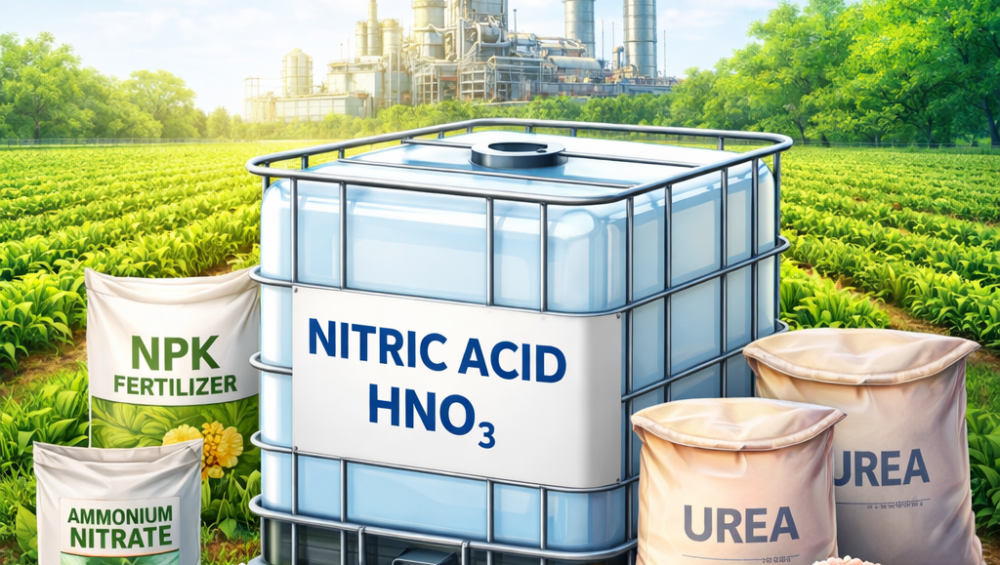
Nitric acid is mainly used to manufacture nitrogen fertilizers such as:

  • Ammonium Nitrate
  • Calcium Ammonium Nitrate (CAN)
  • Urea Ammonium Nitrate (UAN)
  • NPK Fertilizers
  • Potassium Nitrate

These fertilizers provide nitrogen, which is an essential nutrient for plant growth and increases crop yield and food production.

Why Nitric Acid is Called Backbone of Fertilizer Industry

Nitric acid is called the backbone of the fertilizer industry because:

  • It is the main raw material for nitrogen fertilizers.
  • About 80% of nitric acid is used in fertilizer production.
  • It helps convert ammonia into nitrate fertilizers.
  • It supports agriculture and food production.
  • Fertilizer industry depends heavily on nitric acid.

SNDB Chemicals – Manufacturer & Supplier (Nitric Acid)

SNDB Chemicals is a manufacturer and supplier of nitric acid in India, providing different concentrations such as 62% and 70% nitric acid for industrial use. The company supplies nitric acid in bulk packaging including HDPE carboys, drums, and IBC tanks, making it suitable for fertilizer, chemical, pharmaceutical, dye, and explosive industries. SNDB Chemicals focuses on quality control, safe handling, and timely delivery, which makes it a reliable supplier for small and large-scale industries. The company serves both domestic and industrial markets by supplying nitric acid as an important raw material used especially in fertilizer manufacturing, where nitric acid is required for producing ammonium nitrate and other nitrogen fertilizers.